Published: Feb 12, 2026
SoloPath: Predicting your moves, keeping your data safe
SoloPath is a privacy-first machine learning model developed by NCS to predict individual mobility patterns without sending personal location data to the cloud. By processing all data directly on the user’s device, it removes the traditional trade-off between accuracy and privacy, delivering personalised insights while keeping data firmly under user control. As mobility systems become more data-driven, this approach offers a more realistic and trustworthy way to understand how people move. This article explores how SoloPath demonstrates the potential of applied AI to improve urban mobility while maintaining privacy, security, and public trust.
Key takeaways
- SoloPath represents a scalable, real-world model for deploying AI in smart cities, combining strong predictive performance with privacy, security, and trust by design.
- Accurate mobility prediction does not have to come at the cost of personal data privacy.
- By processing data entirely on-device, SoloPath removes the long-standing trade-off between insight and trust.
- This article demonstrates how privacy-first AI can be applied to real-world mobility challenges without compromising performance.
The challenge with traditional mobility prediction
Urban mobility systems increasingly rely on data to improve traffic flow, public transport planning, and city services. However, most existing mobility prediction models depend on large volumes of personal location data being transmitted to and processed in the cloud.
This creates two persistent challenges.
- Privacy risks increase when sensitive location data leaves a user’s device.
- Many standard models struggle to accurately capture individual movement behaviour, particularly when data are noisy, incomplete, or highly personalised.
As a result, organisations are often forced to choose between stronger predictions and stronger privacy safeguards.
A different approach to accuracy and privacy
SoloPath was developed to remove this trade-off. Instead of relying on centralised data processing, SoloPath performs all computation directly on the user’s device. This ensures that personal mobility data remains private by design, while still enabling highly accurate, individual-level predictions.
By focusing on personalised trajectories rather than aggregated movement trends, SoloPath can adapt to unique routines and changing behaviour. This makes it well-suited to real-world environments where human movement is rarely uniform or predictable.
Tested in a global mobility benchmark
SoloPath’s approach was validated through the 2024 Human Mobility Prediction Challenge, an international competition that rigorously tested how well models can predict human movement across cities.
The challenge used a large-scale open dataset tracking up to 100,000 individuals across multiple Japanese cities over a 75-day period. Participants were asked to predict where selected individuals would be over the final 15 days of the dataset, across three cities. The setup also tested whether learning from one city could improve predictions in others.
SoloPath was evaluated on its ability to generalise across cities, not just to predict movement in a single location.
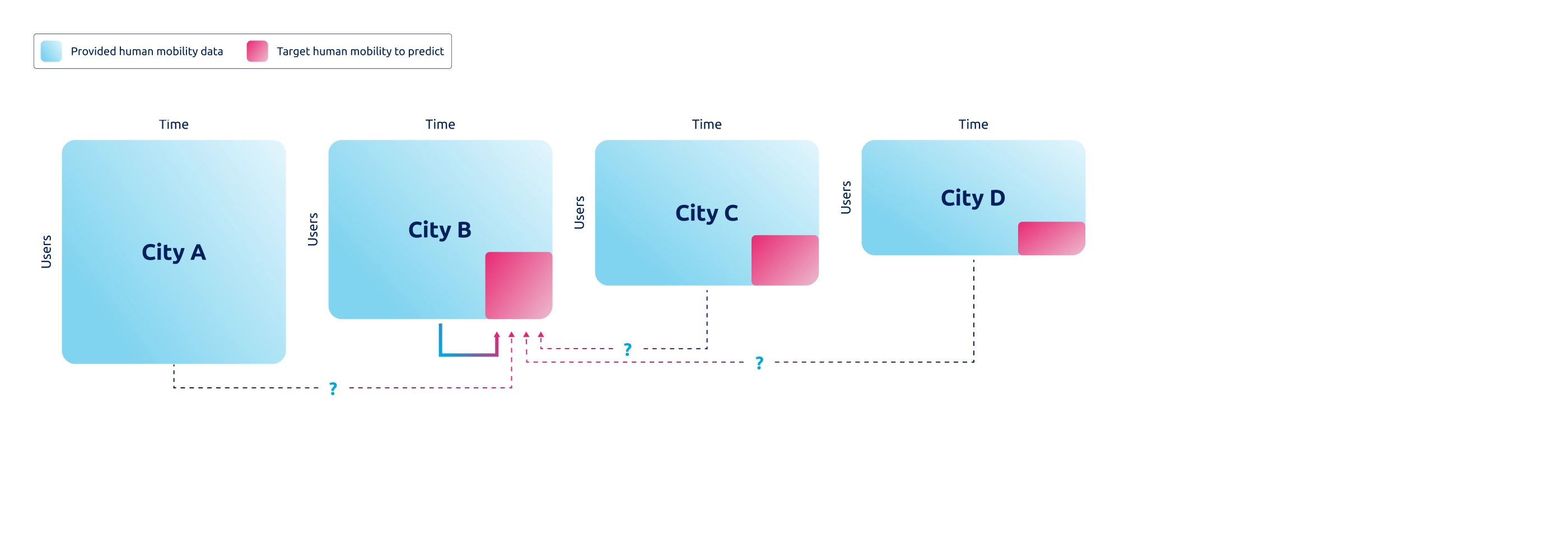
Figure 1: Diagram showing how the Human Mobility Challenge tested prediction accuracy across multiple cities.
This multi-city evaluation was critical. It assessed whether models could generalise across different urban environments, rather than simply memorising patterns from a single location. Among more than 100 research teams worldwide, SoloPath placed in the top 10, demonstrating that a privacy-first, on-device approach can achieve the highest levels of accuracy.
How SoloPath works
At a high level, SoloPath combines thoughtful feature engineering with proven machine learning techniques to deliver reliable, individual-level mobility predictions without compromising privacy.
- Feature engineering for mobility data: Raw movement data is transformed into structured features optimised for decision-tree models, making complex movement patterns easier to analyse and predict.
- Capturing time-based behaviour: Time-based signals are encoded using Time2Vec, enabling the model to recognise both regular daily routines and less predictable, one-off movements.
- Accurate prediction at the individual level: These features are processed using CatBoost, a gradient boosting algorithm well suited to tabular data, allowing SoloPath to deliver precise, individual predictions without overfitting.
Privacy by design, not as an afterthought
Privacy is not an add-on in SoloPath’s architecture. Because all processing occurs locally on the device, personal location data never needs to be transmitted or stored externally. This significantly reduces exposure to security risks while giving users full control over their data.
Crucially, this privacy-first approach does not come at the expense of performance. SoloPath’s results show that strong predictive accuracy and strong privacy protection can coexist when systems are designed with trust in mind from the outset.
Real-world potential for smarter cities
Accurate, privacy-preserving mobility prediction enables secure, real-world AI deployment in smart cities, with clear benefits across multiple urban systems:
- Smarter transportation systems: Improving traffic flow and supporting more responsive public transport planning based on real-world movement patterns.
- Stronger emergency preparedness: Informing evacuation planning and resource allocation by anticipating how people are likely to move in critical situations.
- More personalised urban services: Enabling location-based services that adapt intelligently to individual behaviour without exposing personal data.
Together, these applications show how AI can be deployed at scale in urban environments to improve efficiency while maintaining security, privacy, and public trust.
Predicting movement without compromising trust
SoloPath’s strong performance is more than a technical result. It demonstrates what is possible when advanced AI is designed with robust data governance and privacy at its core.
By combining decentralised data control with high-accuracy mobility prediction, SoloPath represents a scalable, real-world model for deploying AI in smart city environments without compromising public trust. It reflects NCS’s commitment to building responsible, future-ready innovations that lead not only in performance, but also in accountability.
Explore the research behind SoloPath
For readers who would like to explore the technical foundations of SoloPath in more depth, the full academic paper is available in the ACM SIGSPATIAL 2024 conference proceedings.
This publication provides a detailed breakdown of the methodology, evaluation approach, and results from the Human Mobility Prediction Challenge.