Published: Dec 15, 2025
Implementing generative AI projects – Insights, challenges and key learnings
With more than 40 years of experience delivering mission-critical technology projects, NCS has spent the last 18 months helping clients navigate the fast-moving landscape of Generative AI (GenAI). As interest accelerates and tools mature, organisations are exploring increasingly complex use cases through shorter, lower-cost engagements.
From text2sql to multimodal and highly specialised domain applications, our work has surfaced a consistent set of insights around what makes GenAI projects succeed or stall. This article outlines those learnings: from sizing and time-boxing proof of concepts (POCs) to scaling production systems responsibly so that organisations can approach GenAI with confidence and clear expectations.
Key takeaways
- Many GenAI projects struggle due to unclear problem statements and weak data foundations.
- Misaligned expectations between business and technical teams slow progress and limit impact.
- Small, well-scoped use cases with strong cross-functional collaboration produce the most reliable early wins.
- Organisations that invest early in governance, guardrails and workforce readiness scale GenAI more successfully.
Implementing GenAI projects with clarity, discipline and real-world insight
Generative AI has become a major focus for organisations exploring new ways to boost productivity, automate knowledge work, and solve complex business challenges. Over the past 18 months, NCS has supported clients across sectors as they experiment with text2sql, agentic workflows, multimodal applications and highly specialised domain use cases. As technology matures quickly, fuelled by advancements such as DeepSeek and the rise of low-code and no-code tools, clients are increasingly seeking shorter, lower-cost projects that still deliver meaningful insights.
Running effective GenAI POCs
Our experience shows that successful GenAI POCs share a clear pattern. The most effective teams structure their work around a few disciplined practices:
- Time-box engagements to stay focused
Keeping POCs to around two months helps teams balance effort, scope and budget. Longer timelines should be reserved for highly experimental work. The goal is to demonstrate GenAI’s capabilities—and the differentiated value NCS brings—without unnecessarily extending the exploratory phase.
- Avoid sensitive data in the early stages
Where possible, early POCs should use non-sensitive data to reduce complexity and risk. For use cases that cannot avoid sensitive inputs, on-site GPU workstations offer a secure alternative. For most engagements, however, public cloud environments under the NCS subscription provide the right mix of speed, flexibility and operational control.
- Establish clear success metrics upfront
POCs with unclear expectations often fail to progress, even when technically sound. Success criteria must be aligned before work begins. Teams also need to budget time for data cleansing and advanced prompt engineering—both of which significantly influence output quality and user experience.
Challenges in scaling to production
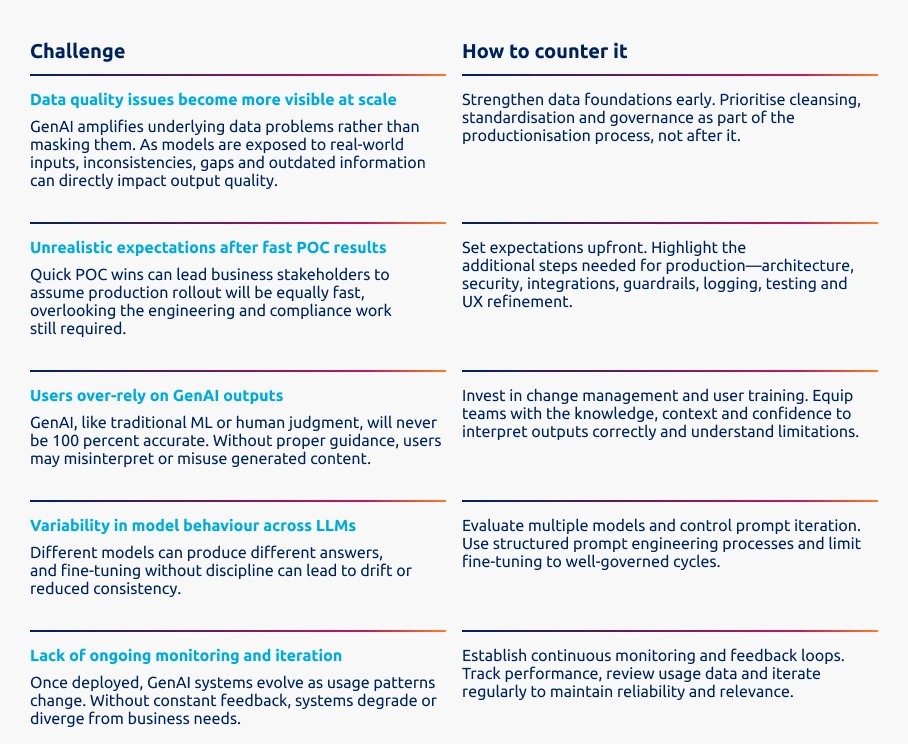
While POCs demonstrate what GenAI can do, production requires deeper rigour. These are the most common challenges teams encounter when making that shift.
Building for scale
Organisations that scale GenAI effectively tend to adopt a cross-functional approach. Establishing a Generative AI Centre of Excellence (CoE)—bringing together expertise in data governance, security, UX, model evaluation and change management—creates consistency across use cases. This approach shifts the focus from one-off turnkey projects to long-term capability building, accelerating overall GenAI maturity.
What this means for your GenAI journey
Generative AI opens powerful new possibilities, but successful adoption requires clear scope, disciplined execution and realistic expectations. Many organisations underestimate the effort needed to move from a fast-moving POC to a secure, scalable production system.
NCS helps clients navigate this complexity by combining deep engineering experience, proven delivery frameworks and access to proprietary tools and accelerators. From early experimentation to long-term operationalisation, we will provide the guidance, structure and cross-functional expertise organisations need to scale GenAI with confidence and control.