Published: Apr 06, 2026
How NCS cut hiring cycles from 30 days to 7 with AI-powered talent orchestration
NCS cut hiring time from 30 days to 7 - here’s how AI is reshaping HR at scale
For large enterprises managing thousands of hires a year, traditional recruitment is slow, siloed, and increasingly unsustainable. Manual screening alone can consume weeks, while disconnected HR functions create bottlenecks from job posting through to onboarding.
NCS built the Adaptive Talent Chain Platform to solve this: a generative AI–powered system that connects the entire talent lifecycle, from screening 3,000 résumés in under 30 minutes to automating scheduling, billing, and employee development. The result: faster hiring, better matches, and a reimagined workforce strategy designed to scale seamlessly alongside the business.
Key takeaways
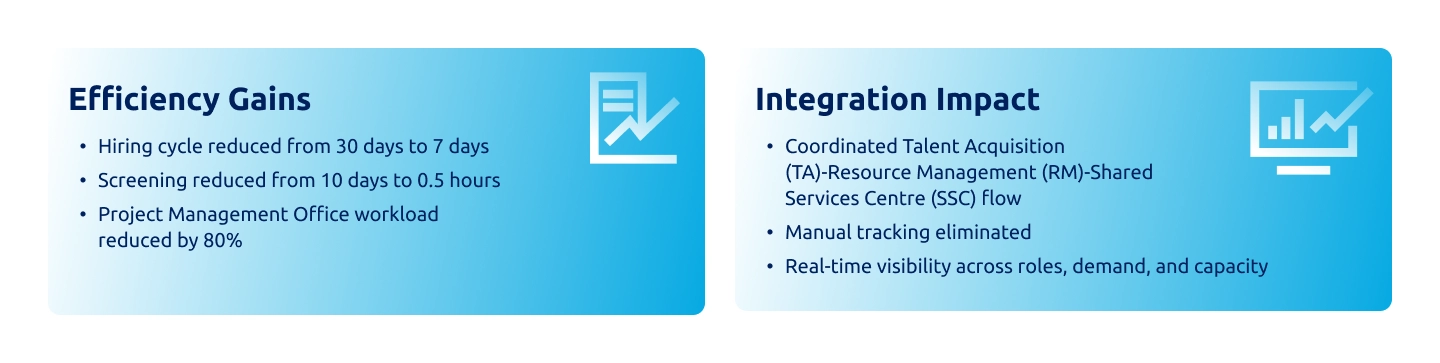
- Hiring cycles reduced from 30 days to 7, with screening time cut from 10 days to under an hour, a 90% efficiency gain.
- AI-driven candidate matching achieves over 95% role-fit accuracy, reducing subjective bias and manual error.
- PMO and finance workload reduced by 80% through automated billing, capacity reporting, and scheduling.
- Personalised learning recommendations increased training participation by 40% and halved skill-up time.
- Built-in PII encryption and role-based access controls ensure compliance without slowing operations.
Speed: from month-long hiring to single-digit days
In large-scale markets like China, NCS corporate teams were spending up to a month filling a single role. Screening 3,000 résumés took five days. Phone interviews for shortlisted candidates added another ten. By the time an offer went out, top talent had often moved on.
The Adaptive Talent Chain Platform changed this by connecting every stage of the hiring workflow – from search and screening through to interview, decision, and onboarding – into a single AI-powered pipeline. Automated screening now processes those same 3,000 résumés in approximately 30 minutes, and AI-generated interview questions reduce preparation time from a full day to one or two hours. The overall hiring cycle has dropped from 30 days to 7.
Scheduling, billing, and capacity reporting are also automated through the platform's coordination layer, removing the spreadsheet-based tracking that previously consumed PMO and finance teams. That workload has fallen by roughly 80%.
Quality: smarter matching, less bias
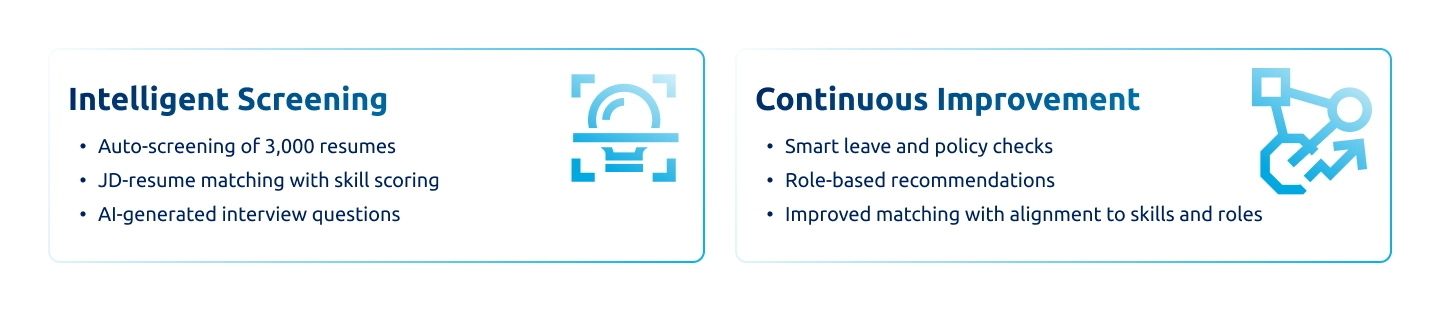
Speed means little if you're hiring the wrong people. The platform's intelligent screening capability scores résumés against job description requirements – technical skills, certifications, experience levels – and prioritises best-fit candidates with explainable recommendations. A Java engineer with a 99% Spring Boot skill match, for example, automatically surfaces ahead of less relevant profiles.
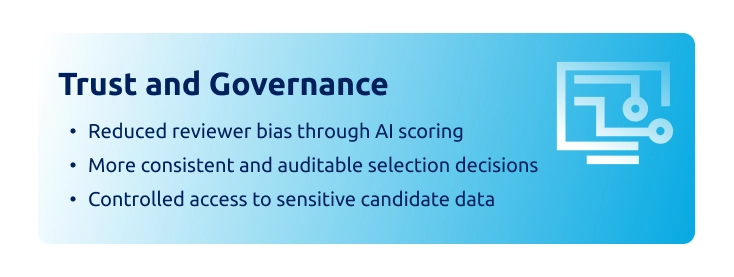
This AI-based scoring achieves over 95% candidate–role matching accuracy, and because the matching logic is transparent, hiring managers can see exactly why a candidate was ranked. The result is more consistent selection decisions and reduced reviewer bias.
Beyond recruitment, the platform's continuous improvement layer supports ongoing employee development. Personalised learning recommendations, such as advanced Figma training for UI/UX designers, have increased training participation by 40% and halved skill-up time. Smart leave and policy checks handle routine queries through a conversational chatbot, reducing leave approval turnaround from three days to one hour.
Compliance: governance built in, not bolted on
Handling thousands of résumés across regions means handling sensitive personal data at scale. Previously, manual handling of personally identifiable information increased compliance and confidentiality risk. The platform addresses this through its unified platform layer: encrypted PII storage with controlled access, role-based permissions, and audit logging baked into every stage of the process.
Standardised résumé templates for third-party suppliers reduce data-handling inconsistencies, while automated policy compliance checks ensure leave and onboarding processes stay within regulatory boundaries. The outcome is a more consistent, auditable selection process and the secure handling of personal data throughout.
How it works: an adaptive intelligence loop
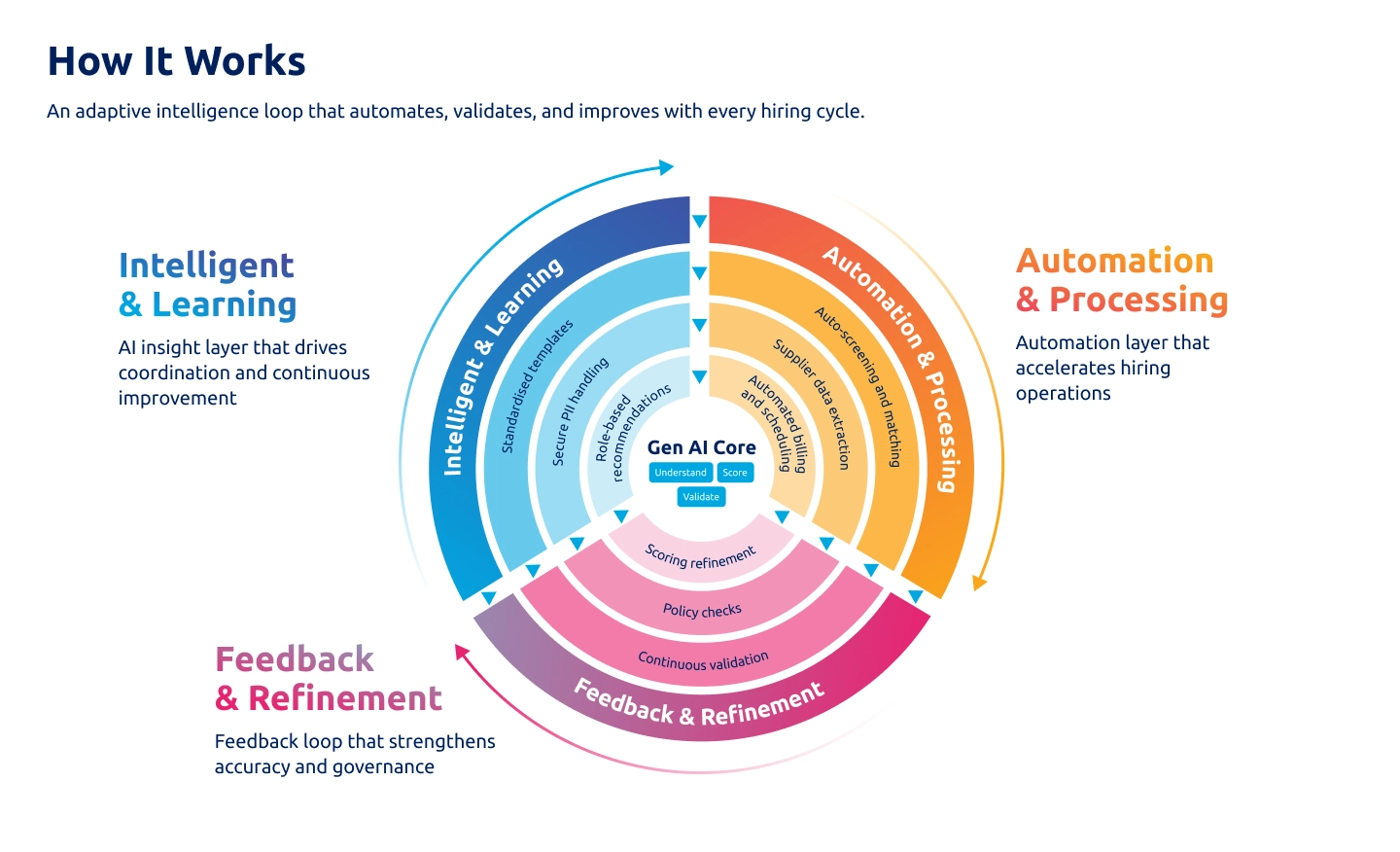
At the core of the platform is a GenAI engine that connects previously siloed HR functions – talent acquisition, resource management, and shared services – into an adaptive intelligence loop that automates, validates, and improves with every hiring cycle.
On one side, the intelligence and learning layer handles standardised templates, secure PII management, and role-based recommendations. On the other hand, the automation and processing layer drives screening and matching, supplier data extraction, and automated billing and scheduling. A continuous feedback and refinement loop, with human-in-the-loop validation at every stage, ensures scoring accuracy improves over time.
This is not a one-off pilot. Core talent acquisition functions are already live for roles including UI/UX designers and Java engineers. With core talent acquisition already live and resource management in testing, the platform's roadmap points towards a fully integrated, AI-enabled HR function, from learning and development through to enterprise-wide workforce planning.
From automation to adaptive orchestration
The Adaptive Talent Chain Platform represents a shift from piecemeal HR automation to intelligent, end-to-end workforce orchestration. By connecting screening, matching, scheduling, compliance, and development into a single AI-driven pipeline, NCS has turned a month-long hiring cycle into a seven-day process – with better outcomes, stronger governance, and a system that improves with every iteration.
For organisations scaling rapidly in competitive talent markets, this is the difference between reacting to hiring demand and staying ahead of it.
Explore how NCS is applying AI across the enterprise
The Adaptive Talent Chain Platform is one of several AI-powered solutions emerging from the NCS. Discover how we’re using agentic AI to transform safety, compliance, and workforce operations.