
AI cut compliance audits from hours to minutes, shifting oversight from reactive to proactive
In any operation where high-stakes decisions are governed by strict protocols, verifying compliance still depends on manual, case-by-case reviews which are often slow, hard to scale, and only surfacing problems after something has gone wrong. NCS built an AI-powered compliance system for an emergency medical services provider that automates post-incident audits, matches patient records to the correct treatment protocol, and generates structured compliance reports in minutes. The result: faster reviews, consistent standards, and early visibility into training gaps, turning compliance from a bottleneck into a governance advantage.
Key takeaways
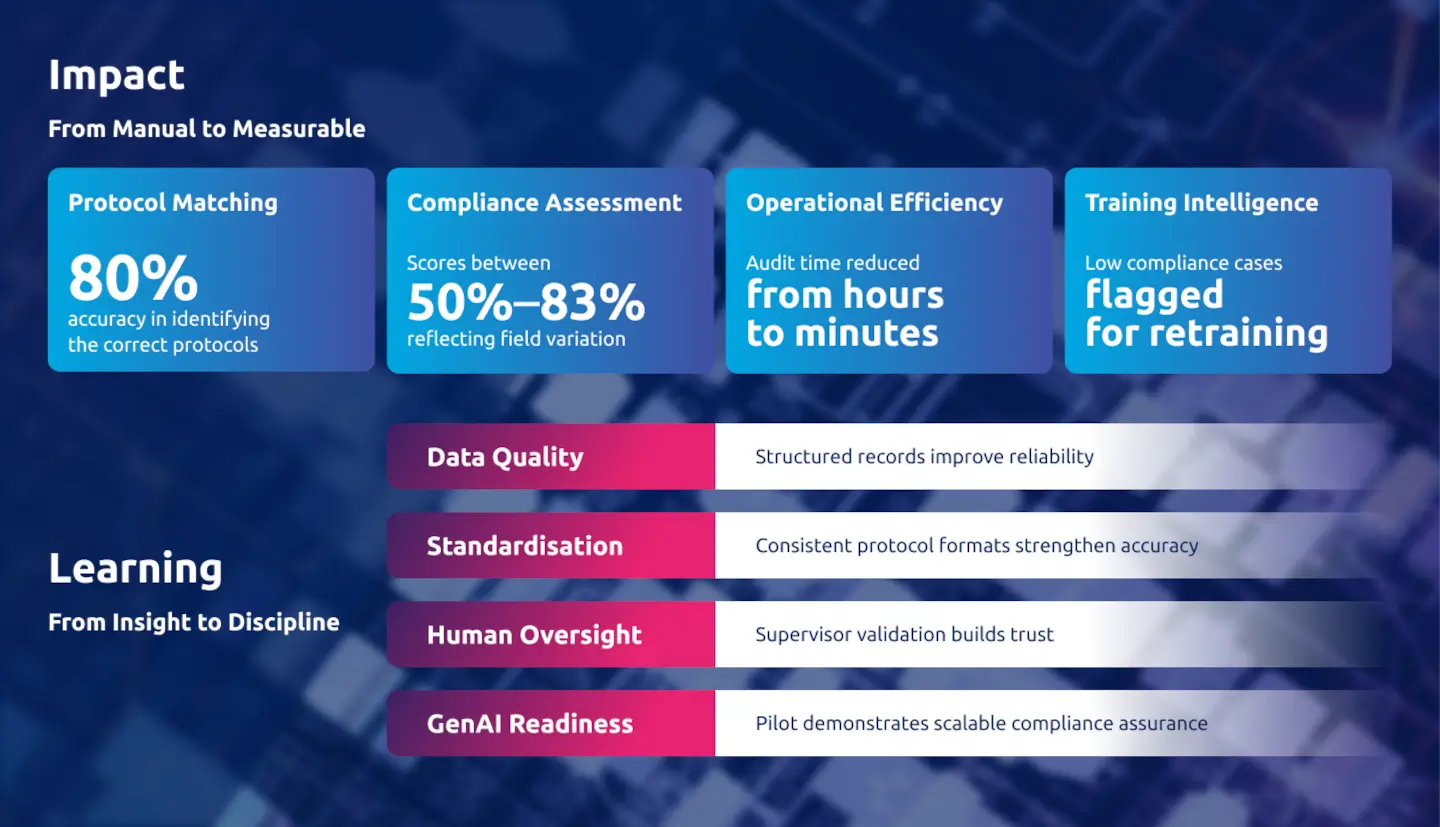
- Manual compliance audits that previously took hours per incident report are now completed in minutes, with AI agents automating protocol identification and adherence checks.
- The system achieved 80% accuracy in matching patient records to the correct treatment protocol from day one, with a clear path to exceed 90% through model refinement.
- Governance shifted from reactive (post-incident discovery) to proactive, with structured reports highlighting deviations, gaps, and targeted training needs before issues escalate.
- Built on Azure-native architecture using GPT-4o, the modular framework is designed to scale across additional protocols, languages, and operational domains beyond emergency medical services.
- Every AI-generated compliance report undergoes human validation, ensuring clinical credibility while reducing administrative workload.
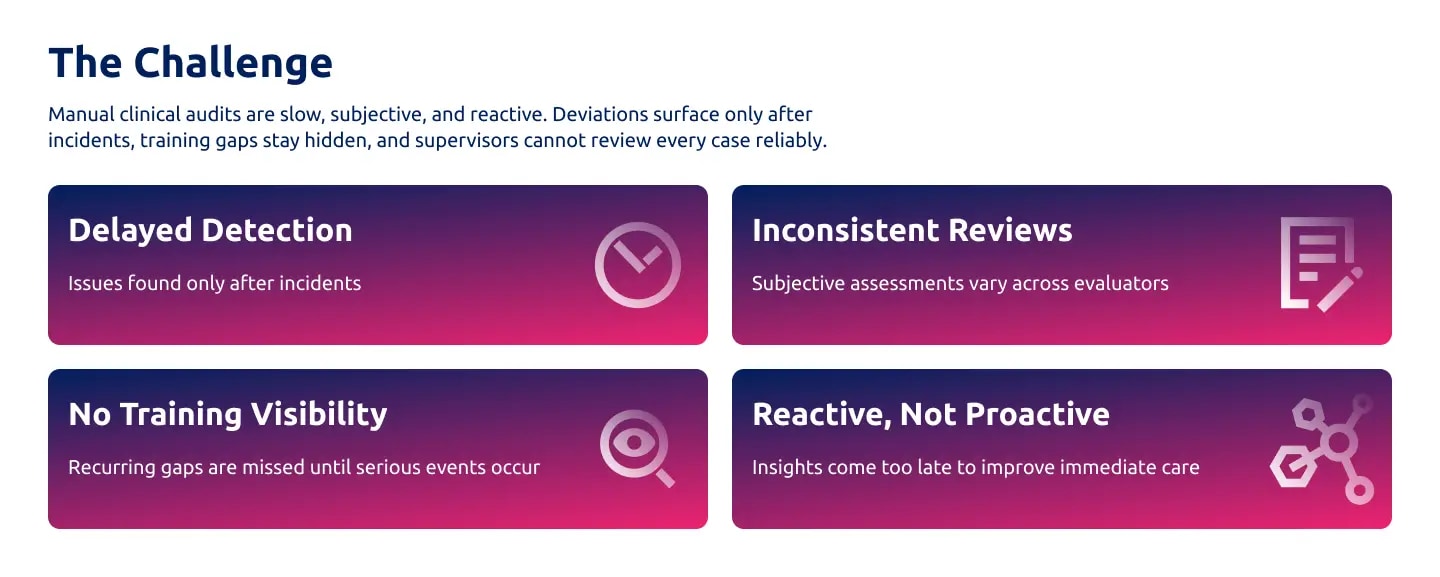
The problem: manual audits that can't keep pace with operational volume
In emergency medical services, every patient interaction follows a defined treatment protocol, a structured decision pathway that guides paramedics from initial assessment through intervention and transport. After each incident, clinical and administrative teams must review the treatment record to verify that the correct protocol was followed, that each step was completed, and that any deviations are documented and addressed.
This review process is almost entirely manual. Auditors compare patient records against complex protocol flowcharts, checking treatment steps one by one. It takes hours per case, demands specialist attention, and is difficult to scale as case volumes grow. When workloads increase, subtle deviations from protocol or incomplete documentation risk going undetected.
The bigger issue is timing. Under a manual model, insights about compliance gaps typically emerge only after a serious incident has occurred. Recurring patterns, training needs, and systemic issues remain invisible until something goes wrong. This reactive approach limits an organisation's ability to strengthen clinical governance, improve consistency of care, and proactively manage risk.
What changed: from end-to-end case checks to exception-led audit
NCS designed an AI-driven compliance system that fundamentally changes how post-incident reviews work. Instead of auditors manually reviewing every case from start to finish, the system automates the heavy lifting, identifying the relevant protocol, comparing it against the patient treatment record, and generating a structured compliance report that highlights only the exceptions: deviations, gaps, and recommended follow-up actions.
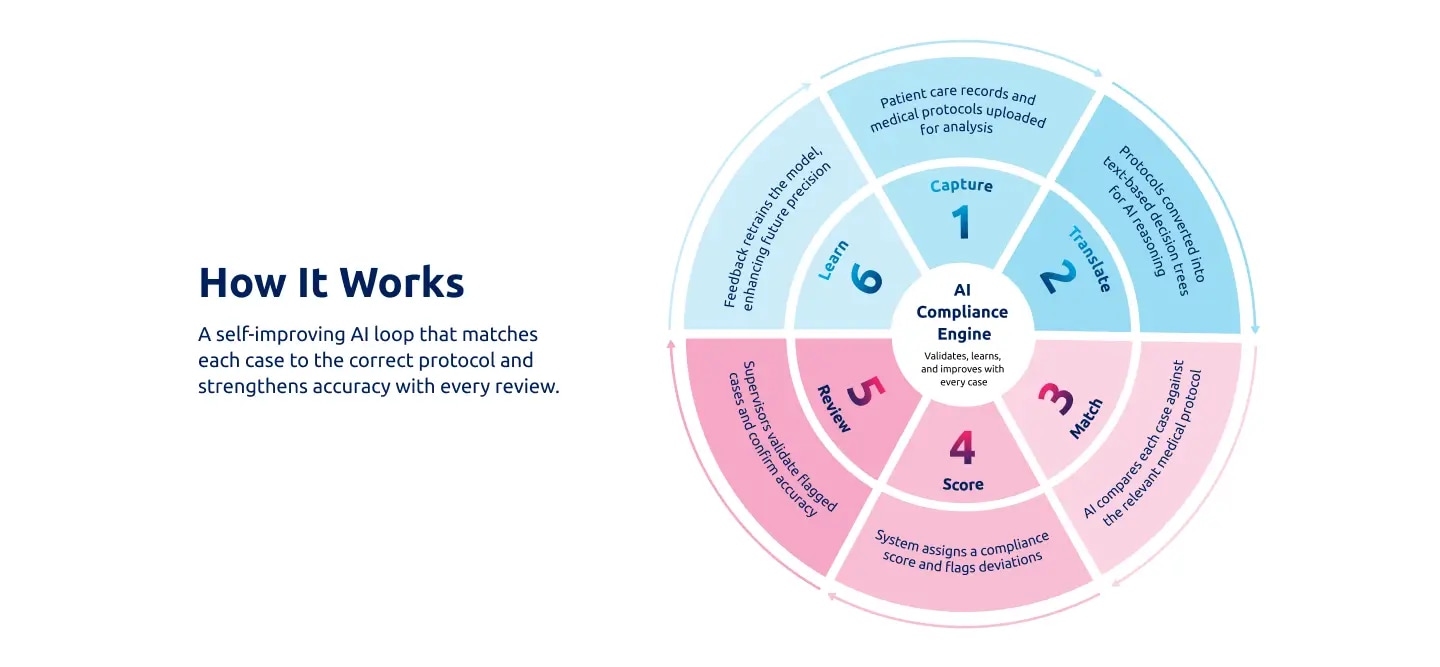
The process works in three stages.
- First, the system converts complex medical protocol flowcharts into machine-readable decision trees. The original protocols are provided as PDFs containing visual flowcharts, conditional branches, and multi-level decision pathway formats that large language models cannot reliably interpret directly. NCS built an automated conversion process that translates these visual elements into structured, text-based logic while preserving the clinical accuracy of every decision point. Each converted protocol is then validated by medical professionals before it is entered into the system.
- Second, when a patient's treatment record is uploaded, an AI agent matches the clinical presentation, symptoms, vital signs, and administered treatments against a consolidated index of all available protocols to identify the correct protocol. In testing, this protocol-matching step achieved 80% accuracy, correctly identifying the same protocol that clinical reviewers selected in eight out of ten cases.
- Third, a compliance analysis agent compares the treatment actions recorded in the patient file against the step-by-step requirements of the matched protocol. It identifies where treatment followed the prescribed pathway, where it deviated, and where steps were missing or incomplete. The output is a structured compliance report that auditors can review in minutes rather than hours, allowing them to focus on the exceptions that matter rather than re-reading entire case files.
Every report is designed for human review. The AI does the processing; clinical professionals make the judgment calls. This combination of automation and expert validation ensures both speed and clinical credibility.
The results: faster audits, earlier intervention, scalable governance
The impact is felt across three dimensions.
- Efficiency: compliance reviews that took hours per case now take minutes, freeing clinical and administrative staff to focus on higher-value work.
- Consistency: every patient record is evaluated against standardised decision logic, reducing variability from subjective manual interpretation.
- And governance: structured compliance reports proactively surface deviations and training gaps, enabling supervisors to intervene early rather than waiting for a serious incident to expose a pattern.
The system also creates a transparent audit trail. Each report provides an evidence-based comparison between what the protocol required and what actually happened, supporting internal quality assurance, regulatory documentation, and future investigations.
Built on Azure-native generative AI architecture, the framework is designed to scale. Additional protocols and treatment areas can be integrated by updating the data store and decision tree library. Planned enhancements include real-time integration with live ambulance data systems for on-the-spot compliance checks, a visual analytics dashboard to track adherence trends and recurring gaps, expanded multilingual support, and a continuous learning loop where new audit results refine the model's accuracy over time.
From reactive review to intelligent governance
The Intelligent Compliance System demonstrates a broader principle: in any domain where high-risk operations are governed by complex protocols, manual oversight eventually reaches a point of diminishing returns. The question is not whether AI can replace human judgement it cannot and should not. The question is whether AI can handle the processing, pattern recognition, and structured reporting that currently consumes specialist time, so that human experts can focus on the decisions that actually require their expertise.
Compliance should not depend on how many hours an auditor can read. It should depend on how intelligently an organisation can see patterns. For emergency medical services, that means faster audits, earlier identification of training needs, and a governance model that improves with every case reviewed. For any organisation managing compliance at scale across healthcare, transport, energy, or financial services, the same framework applies. The protocols change; the principle does not.
Download