Key takeaways
- The AI Adaptive Learning Assistant is a step towards ‘mastery learning’, championed by Benjamin Bloom, which aims to allow students to master a topic before moving to the next.
- The AI Adaptive Learning Assistant has enabled mastery learning through its adaptive quizzes, AI-generated insights and recommendations and a personalised AI tutor to explain difficult concepts and diagrams.
- It also gives educators better visibility into students’ understanding, helping them identify where additional support may be needed.
- Early results show real, measurable gains in student understanding, suggesting that the approach is translating into genuine learning outcomes.
The challenge
In 1968, educational psychologist Benjamin Bloom found that students taught through individualised "mastery learning," where each student is given the time to master a topic before moving to the next, combined with one-on-one tutoring, performed better than 98% of students taught conventionally.[1] While the idea has never been in question, assigning a personal tutor to every student has kept it from becoming a reality.
Additionally, institutes of higher learning (IHLs) have moved towards asynchronous learning in their curricula. While this gives students greater flexibility to learn at their own pace, this often means that students and educators have less contact time for personal coaching. Without timely feedback, some students only discover how far behind they are after examinations, when it's already too late.
This led NP to explore a fundamental question: could learning adapt to the individual, surfacing gaps early and giving every student the timely feedback they need, instead of expecting every individual to adapt to the same system?
The solution
NCS developed the AI Adaptive Learning Assistant together with NP, in partnership with the AWS GenAI Innovation Center (GenAIIC) Partner Innovation Alliance (PIA). The platform is designed to guide students towards deeper mastery of course concepts, at a pace that suits how each student learns.
Rather than being built and handed over, the solution was shaped in close collaboration with NP's education specialists and module leaders throughout development. Their feedback on real student learning behaviour and needs directly influenced how the platform diagnoses gaps and delivers feedback.
Under the hood, the platform runs on Amazon Bedrock, using Anthropic's Claude Sonnet 4.6 to power its generative AI capabilities, such as diagnosing students' learning gaps and generating insights and recommendations. The platform also uses Amazon Bedrock AgentCore, where the AI agent retrieves the relevant lecture material, then breaks the concept down step by step for better understanding.
In practice, this comes together in four ways students experience day to day.
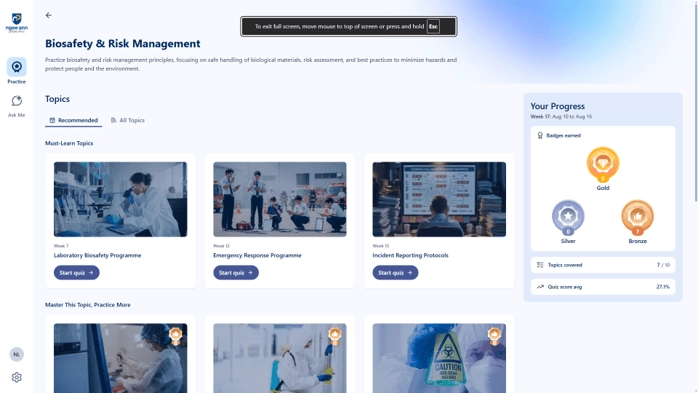
How the platform supports students in self-regulated learning
Adaptive quizzes
The platform generates adaptive quizzes for each topic that the students are learning. The quiz adjusts in difficulty based on the student's real-time performance, progressively guiding them from foundational understanding towards deeper application and analysis of each topic. AI-generated explanations give students immediate feedback after each quiz, helping them understand what went wrong. This keeps students engaged while building both confidence and understanding, step by step.
Personalised learning pathways
The platform analyses each student's quiz performance to identify their strengths and, more importantly, the specific learning gaps they're facing. A Bloom's cognitive diagnosis is then presented to the student, explaining exactly where their thinking breaks down.
The platform then suggests personalised nudges and recommendations to help close those gaps, including:
- Reviewing the specific quiz question(s) they struggled with
- Probing questions that reframe the learning gap while they review their notes
- Suggested questions they could ask their educator, or put directly to the ‘Ask Me’ for a more detailed breakdown
Module Dashboard and Gamification
Students can track their own progress through a module dashboard, which shows their performance by topic alongside badges they've earned along the way. This gives students greater ownership over their own learning journey.
Ask Me: an on-demand AI tutoring assistant
Whenever a student has a doubt, they can turn to Ask Me for instant help, including outside regular classroom hours. Students can even upload diagrams and receive a step-by-step explanation of the concept shown. This provides students timely support while studying independently.
The outcome
Since its deployment across five modules at NP, spanning STEM and non-STEM disciplines, the AI Adaptive Learning Assistant has been rolled out to over 1,140 students. The results so far have been encouraging:
- Meaningful depth of engagement: 214 highly active students generated 1,500 quiz attempts over 10 weeks, with usage peaking around key assessment periods where students needed it most
- Measurable improvement: average quiz scores rose by a statistically significant 16% between students’ first and last attempt, indicating repeated practice translated into real improvements.
- Greater self-direction: students could identify what to study next to close their own learning gaps, supporting more focused, self-directed learning.
- Better visibility for educators: educators gained clearer insight into which topics students found difficult, which questions kept recurring, and who might need additional support.
- More contact time for what matters: with the platform helping close learning gaps on its own, educators can spend their limited contact time on mentoring and coaching instead of repetitive queries.
[1] Michael D. Smith, Carnegie Mellon University. Masters of None: The Flawed Logic of One-Size-Fits-All Education | The MIT Press Reader. Mar 2025