For governments and public safety agencies, the stakes extend beyond impressive, pre-programmed demonstrations. Physical AI is progressing fast, but most of today’s deployments still succeed by narrowing the problem. Robots operate in controlled spaces, perform stationary upper-body tasks such as stationary table-top arm and hand manipulation, avoid autonomous legged navigation, or used wheeled bases to bypass the complex physics of legged balancing. These constraints are understandable, but they expose the real gap between robotics demonstrations and mission-ready physical AI.
For a humanoid robot to be genuinely useful in complex, unscripted environments like emergency response, it must master a dual challenge: executing intricate spatial manipulations with its hands while maintaining precise, dynamic balancing and path navigation with its legs. Furthermore, when obstacles shift or conditions deteriorate, it needs high-level spatial reasoning to break multi-step goals into actionable physical movements.
In an emergency response proof of concept, we explored how a Unitree G1 humanoid, leveraging the NVIDIA Isaac GR00T vision language action (VLA) model and Whole-Body Control, could identify and clear an obstacle blocking an emergency exit.
Gap 1: Physical AI is proven in controlled spaces, but missions are not controlled
Robots are typically proven in structured spaces such as factory floors, warehouses or labs, where routes can be mapped, variables controlled, and risks reduced. But mission environments are different. In emergency situations, conditions can change quickly: visibility may be poor, exits may be blocked, hazards may shift and human teams may need support under time pressure. A mission-ready robot should be able to perceive, reason, and act safely when the environment is changing.
We built this on NVIDIA Isaac GR00T, an open, reasoning, foundation VLA architecture tailored specifically for humanoid embodiments. GR00T models intelligence by explicitly mirroring the dual-process architecture of human cognition, which allows the robot to process its surroundings while taking the right actions and maintaining real-time physical balance:
- System 2 (Slow, Deliberate Reasoning @ ~10 Hz): Powered by NVIDIA’s Eagle-2 Vision-Language Model (VLM). It digests live camera streams alongside natural language instructions (e.g., "Clear the rack blocking the exit door") to build high-level semantic awareness and strategic task plans.
- System 1 (Fast, Reactive Action @ ~120 Hz): Powered by a Diffusion Transformer trained via action flow-matching. It translates System 2’s high-level intent into continuous, ultra-low-latency motor commands.
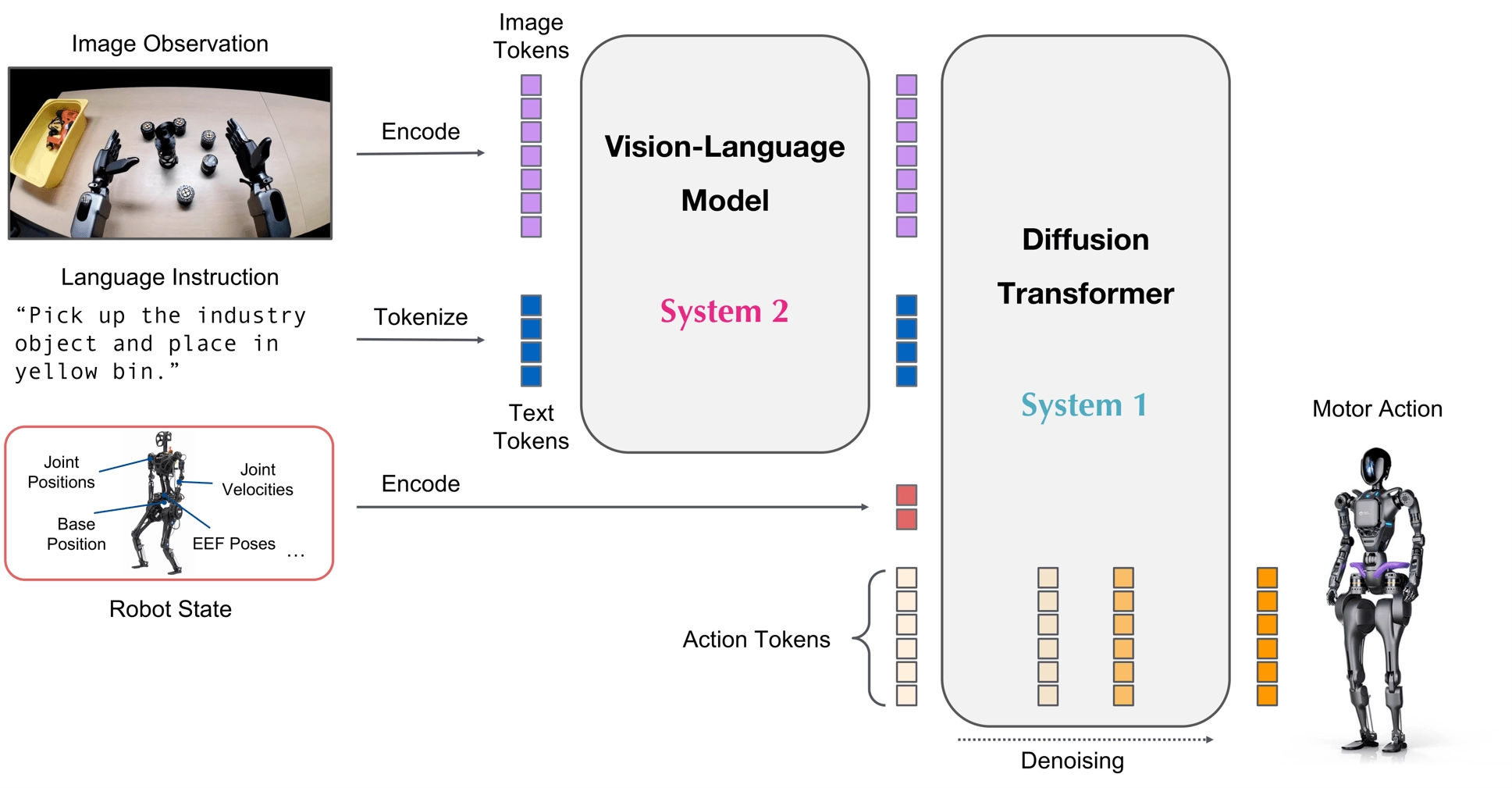
Figure 1. High-level architecture of NVIDIA Isaac GR00T dual-system cognitive engine.
By decoupling cognitive reasoning (10 Hz) from high-speed motor balance (120 Hz) while training both modules end-to-end, GR00T allows the robot to handle complex visual logic without compromising its real-time physical balance.
Additionally, we leveraged NVIDIA Brev to finetune the Isaac GR00T model – it is a GPU-accelerated development platform that gives instant access to GPU instances across multiple cloud providers, preconfigured for AI and ML work. With NVIDIA RTX Pro 6000, the training run took approximately 20 hours to complete 40,000 steps. By the end of the run, it had learned the task pattern enough for the proof of concept.
Gap 2: Move beyond arm-first robots to whole-body control
Upper-body manipulation is only half the battle; clearing a heavy shelf from an emergency exit requires coordinated, full-body pushing while walking. This is where loco-manipulation becomes critical: the ability to combine locomotion and manipulation into one coordinated action. To achieve this, we implemented NVIDIA GR00T-WholeBodyControl using a Decoupled Architecture that separates lower-body locomotion from upper-body posing:
- Lower Body (Locomotion RL Policy): Trained in simulation to handle lower-body balance, stride, and rotation. It translates target directional vectors into dynamic leg motor torque commands, enabling it to turn and apply force.
- Upper Body (Inverse Kinematics): The robot was given target hand positions, such as where to grip the shelf frame. The system then calculated how its shoulder, elbow, and wrist should move to place its hands correctly.
With this approach, our VLA model could focus entirely on high-level navigation and spatial alignment without needing to manually calculate balance dynamics at every frame.
Gap 3: Breakdown complex rescue missions into tactical sub-tasks
“Clear the blocked exit” sounds like one instruction, but for a robot it involves several actions: find the shelf, move towards it, hold the frame, push it away, and check if the path is clear. So, we restructured the continuous emergency mission into targeted, highly efficient sub-tasks:
Sub-Task 1: "Move to the shelf and grasp the frame"
Sub-Task 2: "Push the shelf away from the emergency exit zone"
We also found that Sub Task 1 worked best as one smooth action, because switching instructions at the point of contact made the robot less steady.
Results & Mission Proof of Concept
Deploying our fine-tuned Isaac GR00T 1.6 checkpoint directly onto the physical Unitree G1 delivered a successful proof of concept. The humanoid autonomously identified the obstacle blocking the emergency exit mark, positioned its feet, adjusted its stance via Whole-Body Control, established a firm grasp on the frame, and pushed the obstacle clear of the zone.
Figure 2. Autonomous G1 physical inference successfully unblocking the emergency exit route
The result is an encouraging step for physical AI. Our exploration confirmed that combining VLA architectures with robust Whole-Body Controllers makes real-world emergency response tasks achievable on legged humanoids.
Mission-ready physical AI will not be built by models alone – it will require reliable data, resilient workflows, secure infrastructure, human oversight, and clear governance. Organisations with these foundations will be better positioned to enter this new phase of physical AI.
Acknowledgments
- Dikai Liu — Solution Architect, NVIDIA
- Lim Boon Ping — Senior AI Technologist, NVIDIA
- Ettikan K Karuppiah – Director, NVIDIA