

As published in InAIToday.com
Executive summary
Artificial intelligence is no longer emerging. It is already embedded in how work is executed, often introduced through familiar Microsoft 365 experiences rather than deliberate transformation programs. As a result, many organisations are already using AI without having consciously decided how it should scale or be governed.
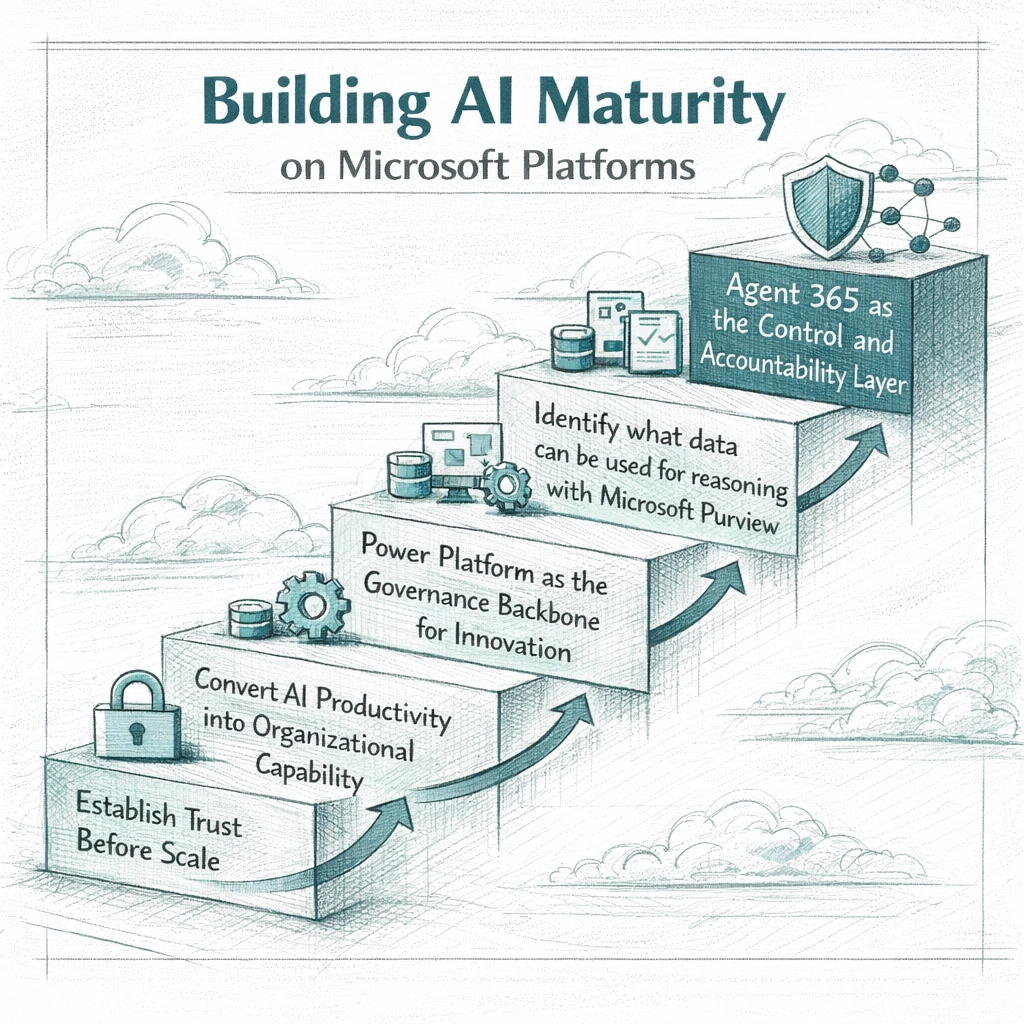
Across those progressing beyond early AI adoption on Microsoft platforms, a consistent set of structural requirements emerges. While organisations move at different speeds, these requirements tend to appear in a recognisable sequence as AI shifts from experimentation to execution.
- Establish Trust Before Scale
- Convert AI Productivity into Organisational Capability
- Power Platform as the Governance Backbone for Innovation
- Identify what data can be used for reasoning with Microsoft Purview
- Agent 365 as the Control and Accountability Layer
These stages are not a prescriptive maturity model, nor are they dependent on specific product releases. They reflect the organisational, governance, and operating constraints that consistently surface as AI moves from assistive use into execution at scale.
1. Establish trust before scale
AI outcomes are only as strong as the data foundations beneath them. In practice, this makes data security, identity, and access control the starting point for AI maturity.
Executives must be confident about what data AI systems can access, how permissions apply in AI assisted scenarios, and whether existing access models remain appropriate. This stage often exposes long standing issues that were previously tolerated, including overly broad permissions, inconsistent content ownership, and legacy governance approaches that become risky once intelligence is layered across the organisation.
A defining characteristic of Microsoft’s approach is that AI operates within existing identity, security, and compliance boundaries, rather than bypassing them. Where trust exists, AI adoption accelerates. Where it does not, progress often slows or stalls.
Trust also extends beyond access into how information is classified, protected, and re-used; considerations that become unavoidable once AI begins reasoning across enterprise content.
Many organisations underestimate this stage. Security and data readiness are sometimes treated as hurdles to clear rather than capabilities to strengthen. In practice, organisations that invest properly here move faster later, because confidence replaces caution.
Trust is not a constraint on AI maturity. It is the enabler.
2. Convert AI productivity into organisational capability
For many organisations, Microsoft 365 Copilot is where AI value first becomes visible. It reduces effort across drafting, summarisation, analysis, and information discovery, so people can spend more time on judgement and decision-making and less on mechanics.
Maturity, however, does not come from access alone. It comes from turning individual productivity gains into repeatable organisational outcomes. These include clearer ways of working, role-based patterns, and shared confidence in when AI is appropriate.
In the early stage, adoption is often uneven. Some teams see immediate benefit, while others struggle with inconsistent outputs, unclear expectations, or scepticism about reliability. The organisations that progress make the shift from general training to platform-specific habits that improve quality and trust:
- Role-specific use cases and prompt patterns (not generic tips)
- Explicit expectations for validating and citing sources in Microsoft 365
- Shared norms for where Copilot is used, and where human judgement must lead
As capability grows, the emphasis shifts beyond assistance toward execution. Capabilities such as Copilot Cowork mark the beginning of this transition. They make visible a shift that many organisations were already approaching, from AI assisting individual tasks to AI coordinating and executing multi-step work across teams. Rather than only helping users produce content, Copilot Cowork can plan and carry out multi-step tasks across Microsoft 365 - drafting, coordinating, routing and updating work across the tools people already use - while still operating inside Microsoft identity, security and compliance controls and keeping people in the loop.
This is typically a turning point. Productivity gains become more material, but so do dependencies on process quality, data consistency, and clear guardrails. When AI can execute work, the organisation needs to be explicit about what can be executed, by whom, with what approvals, and with what audit trail.
This marks a critical maturity shift, from AI assisting work to AI executing work. At that point, governance moves from “guidance” to “operating model”, and that is where Power Platform and Agent 365 become invaluable.
3. Power Platform as the governance backbone for innovation
As automation and AI adoption scales, so does delivery demand. Teams want to build automations, apps, and copilots quickly. Microsoft’s Power Platform is often the route to doing so at pace for low code application development.
Power Apps, Power Automate, and Copilot Studio enable low-code delivery close to the business, using the same identity, data, and policy foundations that underpin Microsoft 365. This is a key advantage, as innovation can happen without stepping outside the platform boundary conditions established in Stage 1.
But speed introduces a predictable risk. Without common patterns and guardrails, organisations see duplicated solutions, inconsistent standards, unclear ownership, and rising support overhead. When multiple teams are building copilot agents and automations, fragmentation becomes a governance problem, not just a delivery nuisance.
Organisations that mature successfully establish a Power Platform Centre of Excellence (CoE). The CoE is not a control function. It is an enablement capability that makes safe innovation repeatable through shared patterns, environment strategy, data and connector policies, lifecycle management, and clear accountability.
This is often a decisive stage. Without leadership intent, innovation either stalls or splinters. With it, Power Platform becomes the governed backbone that allows AI-enabled delivery to scale across the enterprise rather than proliferate as isolated efforts.
Power Platform governs how solutions are built and operated. It does not, on its own, resolve questions of information sensitivity, retention, or reuse once AI begins reasoning over enterprise content at scale.
4. Identify what data can be used for reasoning with Microsoft Purview
Once AI begins executing work rather than supporting individual tasks, the risk profile changes. The concern is no longer just what systems AI can access, but what information it can reason over, infer from, and re-express.
Microsoft 365 Copilot and emerging agentic capabilities operate across emails, documents, chats, meetings, and data repositories. In doing so, they surface patterns, connections, and insights that were previously buried across silos. This is where many organisations encounter their next maturity constraint.
Information that was technically accessible but poorly classified, inconsistently labelled, or governed only by convention suddenly becomes visible, summarised, and reusable. Longstanding information management issues that were tolerated in a pre-AI world become material risks when AI can synthesise and redistribute content at speed.
This is where Microsoft Purview becomes foundational to AI maturity.
Purview provides the information governance capabilities required to operate AI confidently at scale, including data discovery, sensitivity classification, retention, insider risk, and compliance controls that extend naturally into Copilot and agentic experiences. It ensures that AI systems respect not just access permissions, but also data context, sensitivity, and organisational intent.
Organisations that mature successfully treat Purview not as a compliance afterthought, but as an enabling layer that allows AI to operate safely. They invest in classification strategies that reflect business realities, align retention and protection policies to how information is used, and ensure that leadership can answer practical questions such as:
- What information can AI surface, reuse, or infer?
- How do we prevent sensitive context from being recombined unintentionally?
- Can we trace, explain, and defend AI derived outputs?
Without this discipline, AI adoption either slows under risk concerns or accelerates into fragile territory. With it, AI can reason over enterprise information with confidence rather than caution.
At this stage, AI maturity is no longer defined by experimentation or capability. It is defined by whether the organisation can scale intelligence across its information estate without increasing risk exposure.
5. Agent 365 as the control and accountability layer
With information governed through Purview and low code application development governed through Power Platform CoE, the final challenge becomes oversight of autonomous agents.
As organisations approach more advanced operational use of AI it must be treated with the same discipline as any other enterprise platform capability, with clear ownership, operational monitoring, risk management, and continuous improvement.
The absence of these disciplines is one of the clearest signs that AI maturity has plateaued. When copilots and agents proliferate without consistent oversight, organisations lose visibility into what is running, what it can access, and what it is changing.
As AI agents become more autonomous, leadership concerns shift from “can we?” to “can we control it?”. CISOs and risk teams ask practical questions: Where are agents deployed? What data can they access? What actions can they take? What approvals are required? If something goes wrong, who is accountable?
This is where emerging capabilities such as Microsoft Agent 365 become important. Agent 365 is designed to act as a governance, control and accountability layer for agentic AI, providing visibility of deployed agents, policy enforcement, security controls, and the operational oversight required to run agents safely at scale. Its value is not novelty, it is confidence.
The need for this level of control and accountability predates any specific product. Security, risk, and operations leaders have been asking these questions as soon as agents began executing work, regardless of tooling.
At this level, AI is no longer experimental. It is infrastructure, and it must be controlled and operated accordingly.
Final thought
Most organisations will not struggle with AI because of technology. They will struggle because execution outpaces trust, or because agents and automations scale faster than the controls that should surround them.
On Microsoft platforms AI maturity emerges through intent, not through early adoption of tools, but through deliberate progression from trust, to execution, to controlled operation.
The organisations that succeed will not be those that adopt AI first. They will be the ones that build a defensible platform capability, where AI can execute work, at scale, with governance and accountability.