



Why AI needs business-owned data products, not another platform upgrade
Australian organisations have spent the past five years modernising their data estates: cloud migrations, lakehouses, consolidated warehouses. Most of that engineering worked. The value question did not go away. Boards that approved AI spending in 2024 and 2025 are now asking what came back, and in many organisations the honest answer is a handful of pilots and not much that moved a number the business cares about.
The gap is rarely the technology. At NCS, we challenge the assumption that more platforms, more data or more AI automatically create more value. The real question is whether organisations have the business context needed to turn information into decisions.
AI creates value from context, not from data alone. A model can query a table. It cannot tell who owns the figures, whether they are current, what a column means in this business or which decisions the data is fit to support. A data product carries the organisational context, business meaning and accountability needed to ground AI and unlock its true value.
The dataset delusion
Rename a dashboard a "data product" and you have a dashboard with a longer name. Plenty of organisations have relabelled datasets, reports and extracts this way without changing who owns them, how they are funded or whether anyone maintains them. The test is blunt: if removing the word "product" changes nothing about how the asset is owned, funded and improved, it was never a product.
Most of these assets were built for one purpose, for one requester, and abandoned the day the project closed. They are hard to find, harder to trust and impossible to reuse. That is not a naming problem. It is an ownership problem.
What makes a data product different
A data product is built to solve a business problem for identified consumers. It has customers, a named owner, measurable outcomes and a lifecycle that continues after the first release.
The data mesh literature (Dehghani, 2020) provides a useful checklist. A data product is discoverable, so consumers can find it without asking around. Addressable, with a stable location and interface. Trustworthy, with quality measured and published rather than assumed. Self-describing, so meaning, lineage and permitted use travel with the data. Interoperable, so it combines with other products without bespoke rework. Secure, with access enforced at the product rather than the platform perimeter. And business-owned, with a named person who answers for it.
Six of those seven are engineering work. The seventh is the one organisations avoid, and it determines whether the other six survive contact with reality.
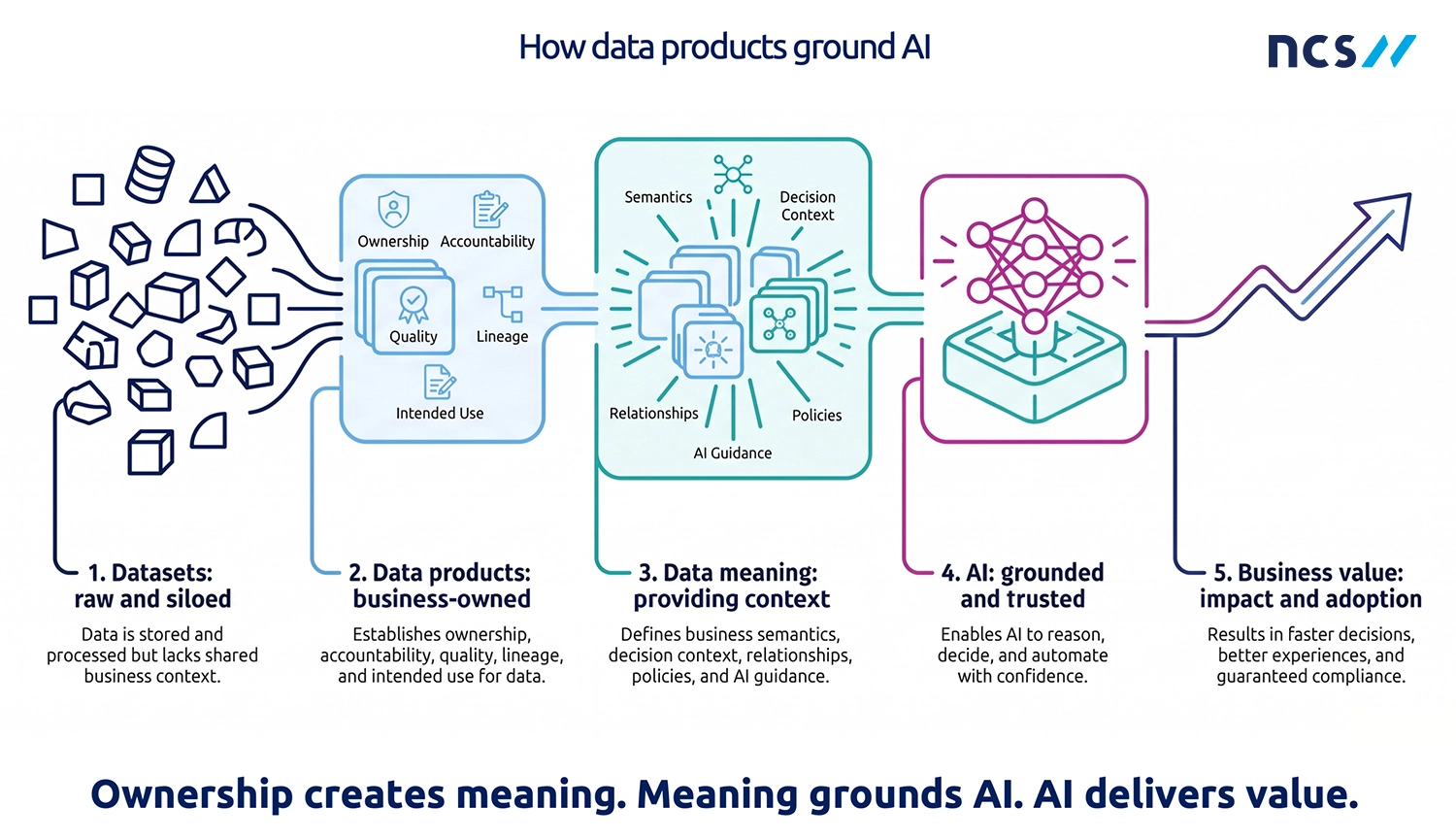
Ownership is how data products scale
No platform confers ownership. Getting to real data products means appointing data product owners with actual authority, standing up cross-functional teams, funding products the way software products are funded (persistently, not per project) and building governance into delivery rather than reviewing it afterwards. Projects end. Products are commitments. That shift is uncomfortable, which is why so many organisations stop at the renaming stage.
For regulated Australian organisations the choice is narrowing anyway. In the Financial Services sector, The Australian Prudential Regulation Authority's CPS 230 requires accountability for the data that critical operations depend on. The Privacy Act reforms raise the cost of holding data nobody owns or can explain. AASB S2 puts climate disclosure data on an audit footing. "Nobody owns it" has stopped being an answer a regulator will accept.
Introducing ownership into the operating model requires pragmatism. Organisations cannot expect business stakeholders to become effective data product owners overnight. In most cases, however, the underlying ownership already exists. The domain expertise, decision-making authority and accountability sit within the business today. Data product operationalisation simply formalises these responsibilities and provides a mechanism to maintain the business context attached to data over time.
This becomes increasingly important as organisations scale AI. Critical knowledge often exists as explicit information spread across documents, policies and systems, or as implicit knowledge held by experienced subject matter experts. Data products create a structured way to capture, maintain and govern that knowledge through ownership, metadata, business rules and operational processes. As business priorities, processes and policies evolve, the meaning attached to data evolves with them.
At NCS, we challenge organisations to think beyond data platforms and focus on how business knowledge is created, maintained and scaled. The strongest outcomes come from treating data products as business capabilities, not technical assets. We are currently helping organisations across industries put these principles into practice, from establishing sustainable ownership models to embedding business meaning into data products that can support AI at scale.
Large Australian Superannuation fund
NCS is helping the organisation establish data products with clear ownership, governance processes and AI guidance metadata. Business definitions, decision rules and data relationships are maintained as part of the product lifecycle, ensuring organisational knowledge remains current and accessible. By embedding ownership around business semantics and data meaning, the organisation is creating a sustainable mechanism to preserve context as the business evolves. This enables AI consumers and agents to access grounded, business-specific knowledge and deliver more reliable, explainable and tailored outcomes.
Global trading platform
NCS is partnering with technology and operational teams to co-design the transition to a data product operating model. Rather than attempting to establish full business ownership from day one, the organisation is adopting a phased approach using proxy data product owners, including analysts embedded within the business. This pragmatic model maintains delivery momentum, demonstrates value early and creates a practical pathway towards sustainable business ownership.
While the approaches differ, both organisations are solving the same problem: ensuring business context remains connected to data as the organisation evolves. Ultimately, the value of a data product is not the data itself, but the business meaning that travels with it. Ownership ensures that meaning remains accurate over time, enabling both people and AI systems to make decisions with greater confidence. That capability becomes even more important as AI moves from experimentation into day-to-day decision-making.
Why AI raises the stakes
The next generation of AI systems reasons across business knowledge rather than simply querying databases. Hand an AI agent ungoverned data and it will not fail loudly. It will produce fluent, confident answers built on figures nobody stands behind, at a speed no manual review can catch. Organisations that skip the ownership work do not automate intelligence; they automate inconsistency.
Data products give AI the same things they give any consumer: meaning, provenance, quality signals and a person accountable for the answer. That is what makes AI output explainable and defensible, which for a regulated entity is the difference between a tool and a liability.
Where to start
Not with a platform programme. Pick one decision the business makes slowly or badly and trace the data behind it. Appoint one owner from the business side, with the authority and funding to fix it. Ship one data product against a measurable outcome inside 90 days and let the result argue for the second. Product operating models spread on evidence, not on mandates.
A challenge for Data & AI leaders
The organisations that get value from AI over the next five years will not be the ones with the biggest platforms. They will be the ones with the clearest ownership, the strongest business context and the most usable data products.
At NCS, we challenge organisations to rethink what makes data valuable. If your data product catalogue would read exactly the same with the word "product" deleted, challenge the assumption that you have data products at all.
Start again.
This time, start with ownership. Start with meaning. Start with the decisions the data is intended to support.
Because AI does not create value from data alone. It creates value from context.