Moving agentic AI from experimentation to execution
Across Australian enterprises, artificial intelligence has reached a critical turning point. Over 78% of organisations are actively deploying or experimenting with generative AI capabilities. Teams are drafting emails faster, generating meeting summaries and using AI assistants to speed up individual tasks.
Despite this momentum, less than 5% of enterprises have brought autonomous AI process agents into full production or achieved measurable P&L impact. The challenge for business leaders is clear: how can they turn growing AI adoption into meaningful business outcomes?
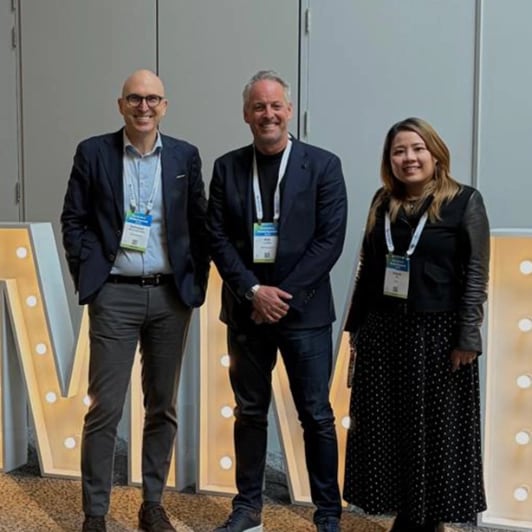
This was one of the key questions explored at an executive breakfast briefing hosted by NCS Australia and Google Workspace in Sydney. Bringing together business and technology leaders, the session examined what organisations should automate next, highlighting the importance of selecting the right workflows, connecting information across systems, and preparing people and governance for broader AI adoption.
The biggest opportunity now is to rethink how work gets done. The goal is not simply to add another platform. It is to identify the right workflows, connect the right information, empower people to adopt new ways of working, and build governance into the process from the start.
What businesses need to know
Many organisations have started experimenting with agentic AI. The challenge is turning those early wins into meaningful business outcomes. That was the focus of the recent executive session where NCS Australia and Google brought technology leaders together to explore how organisations can take the next step.
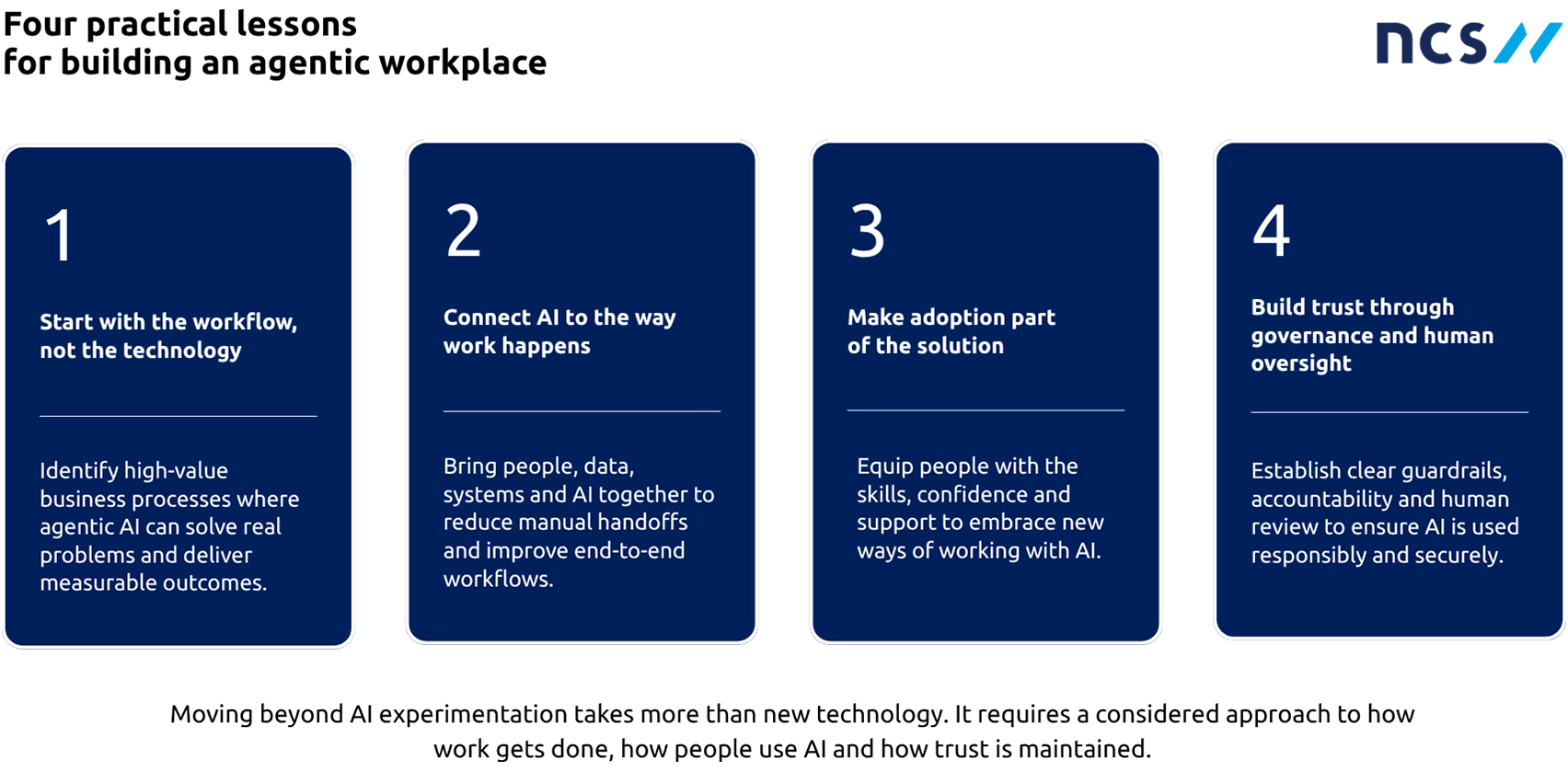
Here are four practical lessons for organisations ready to take the build an agentic workplace.
1. Start with the workflow, not the technology
Where should you first apply agentic AI to deliver measurable business value?
More AI licences do not automatically mean better business results. If your employees are still manually moving information between emails, documents, and business systems, adding another AI assistant may speed up individual tasks without fixing the underlying inefficiencies.
Identify where work gets stuck. Look for high-volume, repetitive workflows, unnecessary handoffs and decisions delayed by fragmented information. These are the places where agentic AI could help connect tasks, coordinate processes, and reduce manual effort.
You can start with one or two high-impact workflows. Prove the value, learn from the results, then build your roadmap for wider adoption.
Start where agentic AI can make the biggest measurable difference.
2. Connect AI to the way work happens
AI can help an employee draft an email faster, summarise a meeting, or find information. But what happens next? Someone may still need to search for supporting documents, copy information into another system, and chase approvals before the work is complete. The time saved on one task can quickly disappear across the wider process.
You can explore how AI assistance and agents can help people find relevant information, prepare outputs, and coordinate multi-step workflows within their existing ways of working, subject to the right integrations, permissions, and controls.
To move beyond individual task acceleration, the key is connecting workflow steps. Map the workflow, identify where time is lost, and explore how a connected workflow could improve the outcome.
3. Make adoption part of the solution
A well-designed AI solution can fail to deliver value if employees do not trust it, understand it or know when to use it. How do we ensure people use AI to change how they work?
During the session, our experts shared practical perspectives on embedding Google Workspace into everyday operations across a franchise environment. The lesson for technology leaders is clear: adoption works best when new capabilities address real problems within familiar routines.
Start with a small number of high-value use cases, involve the people doing the work, and measure whether the changes improve outcomes. Track practical indicators such as time saved, process completion times, quality, and user adoption. Use those results to refine the solution before scaling it.
Adoption is not the last step after implementation. It is part of the transformation from day one.
4. Build trust with governance and human oversight
As AI moves from generating content to taking actions across workflows, organisations need clear boundaries around what agents can access, recommend, and execute. How can we use AI agents without losing control?
In the session's live demonstration, we highlighted an AI-assisted workflow that extracted information from an incoming request, referenced relevant documents, and prepared a decision package for human approval before the final action.
This illustrates an important principle: autonomy should be designed around the risk of the task.
Organisations should define access permissions, approval thresholds, monitoring, audit trails, and escalation paths. Lower-risk tasks may be suitable for greater automation, while consequential decisions may require explicit human sign-off.
Turn your agentic AI ideas into an actionable roadmap
You know AI has potential. The question is which opportunities are worth pursuing first.
For many organisations, the challenge is not producing ideas. It is deciding which use cases can deliver meaningful business value, whether the underlying data and systems are ready, and what it will take to move from a pilot to implementation.
Bring a business challenge and let us use the workshop to identify where agentic AI can create the most value for you.